

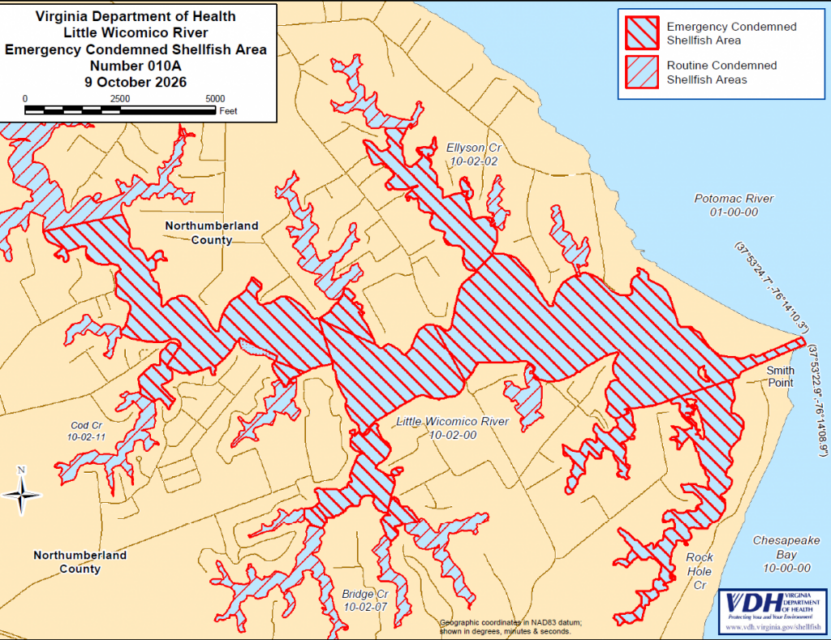
The Virginia Department of Health has closed the Little Wicomico River to shellfish harvest indefinitely, with Shellfish Area Condemnation Order 010-105 taking effect November 8, 2026, no expiration date, and three consecutive rounds of clean oyster tests required before it reopens. The order replaces the 30-day emergency closure that began October 9 after raw oysters from Little Wicomico Oyster Company were tied to a SalmonellaTelelkebir outbreak that, as of CDC’s October 30 count, has sickened 28 people in 13 states and hospitalized five. No deaths have been reported.
The new order has no expiration date and cancels two older ones.
The emergency closure VDH issued October 9 was written to run through November 7. The outbreak page, last updated November 6, says that because oysters sampled October 13 and October 21 tested positive for Salmonella, VDH is extending the closure beyond the 30 days. The new order, posted the same day, condemns the Little Wicomico River and its tributaries upstream of a line near the river mouth, prohibits taking shellfish there except by permit from the Marine Resources Commission, and cancels the two notices that had governed the river before: the upper-river notice of August 15, 2025, and the lower-river notice of June 15, 2026. It states no end date. VDH says it will consider petitions to reconsider or revise the order at any time.
Two rounds of oysters were positive and two rounds are still at the lab.
Reopening requires three consecutive negative rounds of product testing from the growing area. VDH’s own timeline shows how far away that is.
| Date | Sample | Result |
| October 13 | 400 oysters from company cages; eight meat samples to the state lab | Positive; outbreak strain Telelkebir plus Salmonella Newport and SalmonellaHartford |
| October 21 | Second 400-oyster round, four company leases | Three of four leases positive, one negative; sequencing pending |
| October 22 | Fecal contamination samples | No result posted |
| October 26 | Oyster meat from public harvest grounds | Negative |
| November 2 | Third 400-oyster round from company cages | Pending |
| November 4 | Water and oysters from public grounds, sent to UNC | Pending |
Source: VDH Salmonella outbreak page, last updated November 6, 2026, read November 9, 2026. Check: six sampling events, two positive, one negative, three with no result posted, which sums to six. Reopening needs three negatives in a row; as of November 9 the count of consecutive negatives from the company leases is zero.
CDC counts 28 sick in 13 states; Virginia counts three of its own.
CDC’s notice, last updated October 30, lists 28 people infected with the outbreak strain in 13 states, five hospitalized and no deaths. VDH says three Virginia residents are among the sick. Of the 28, eleven reported eating raw oysters, and shellfish tags traced seven of those meals: two to a single source, both in Virginia, and five to several possible sources in Virginia, New Jersey, Massachusetts, Georgia or Canada. VDH calls its information preliminary and says additional cases beyond the 28 are under investigation. Food Poison Journal has followed this outbreak since Virginia found the outbreak strain in oysters from all four company leases and through the first lawsuit, filed for a Colorado woman. Marler Blog has asked how Salmonella got into the river in the first place.
The recalled oysters were harvested September 18 to October 8 and shipped to 15 states and D.C.
The voluntary recall covers shellstock oysters harvested from the Little Wicomico River between September 18 and October 8, 2026, by Little Wicomico Oyster Company, dealer permit VA-1421-SP. VDH lists distribution to Colorado, Connecticut, the District of Columbia, Florida, Georgia, Illinois, Maryland, Missouri, North Carolina, New Jersey, Nevada, New York, Pennsylvania, Virginia and Texas; FDA’s alert adds California. Publix sold some of them as James River Oysters through October 14. Oysters are perishable, so recalled product should be gone from restaurants and seafood counters by now, but anyone who froze or shucked and refrigerated raw oysters bought in late September or early October should throw them out. VDH says the company remains a certified shellfish dealer and that inspections found no deficiencies in its operations linked to the illnesses; the company is harvesting from other Virginia waters.
Salmonella symptoms start six hours to six days after eating.
CDC says Salmonella symptoms usually begin six hours to six days after infection: diarrhea, fever and stomach cramps, sometimes with nausea, vomiting and headache, lasting four to seven days. Most people recover without antibiotics. See a doctor if you have diarrhea with a fever over 102°F, bloody diarrhea, vomiting that keeps you from holding down liquids, signs of dehydration, or diarrhea lasting more than three days. Children under five, adults over 65, pregnant women and people with weakened immune systems are more likely to be hospitalized. A small number of people develop reactive arthritis in the weeks after the infection clears.
Is the Little Wicomico River open for oysters again?
No. Virginia closed it to shellfish harvest indefinitely under Order 010-105, effective November 8, 2026. It stays closed until three consecutive rounds of oyster tests come back negative; as of November 9 two rounds were positive and two were pending.
How many people are sick from Little Wicomico oysters?
CDC counted 28 people in 13 states as of October 30, 2026, with five hospitalized and no deaths. Virginia says three of them are Virginia residents and that more cases are under investigation.
I ate raw oysters in October and got sick. What should I do?
See a doctor, tell them you ate raw oysters and ask for a stool test for Salmonella. Keep any receipt, menu or shellfish tag. Your local health department will want to know the date and the restaurant or store.
About Marler Clark. Marler Clark, The Food Safety Law Firm, has represented victims of Salmonellaoutbreaks for more than thirty years and represents a Colorado woman sickened in this outbreak. If you or a family member became ill with a Salmonella infection after eating raw oysters, contact the firm’s Salmonellalawyers for a free case evaluation at 1-800-884-9840.