

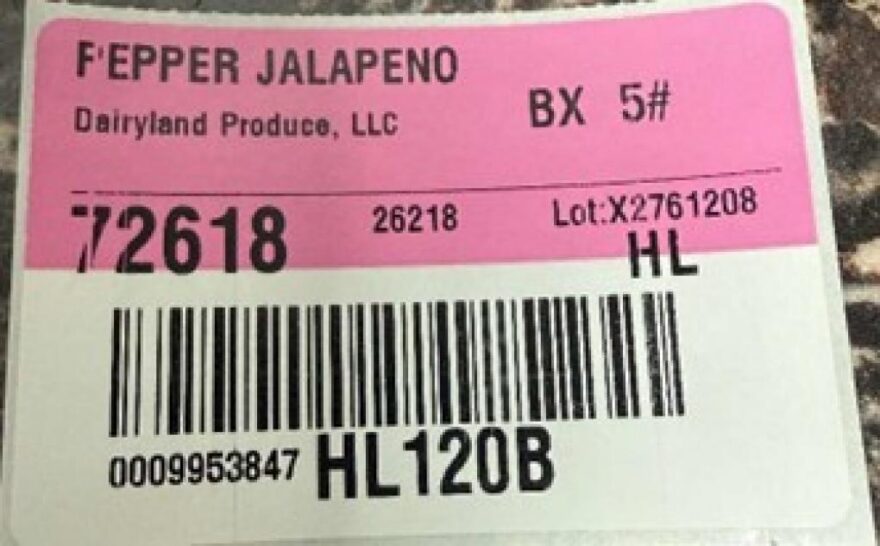
Dairyland Produce, LLC, doing business as Hardie’s Fresh Foods of Houston and Dallas, is recalling PEPPER JALAPENO 5# because the peppers have the potential to be contaminated with Salmonella. The company dated its announcement August 12. FDA published it August 17.
The peppers went to two Costco warehouses in Texas: Store #1487 at 12717 Network Drive in Stafford, and Store #0655 at 8282 Park Lane in Dallas. They were sold in clear plastic bags with a stick-on label. Seven lot codes are recalled, with five production dates behind them. Hardie’s repacked the peppers and has ceased production and distribution. If you have them, return them to Costco for a full refund. The company’s consumer line is 1-281-697-7067, Monday through Friday, 8 a.m. to 5 p.m. Central.
| Lot Code | Production Code | Production Date |
| X2741775 | 26192 | July 11, 2026 |
| X2741859 | 26196 | July 15, 2026 |
| X2744163 | 26197 | July 16, 2026 |
| X2744706 | 26199 | July 18, 2026 |
| X2746349 | 26203 | July 22, 2026 |
| X2746490 | — | — |
| X2748743 | — | — |
The production codes are Julian dates, and they are worth knowing how to read, because the bag in your hand may carry the code rather than the date. The last three digits are the day of the year: 192 is July 11, 196 is July 15, 197 is July 16, 199 is July 18, and 203 is July 22. Two of the seven lot codes carry no production date at all in the notice.
What the notice tells a shopper is thin. There is no best-by date, no sell-by date, and no purchase window — nothing that would let a Costco member who bought jalapeños in July match a receipt to a recall. There is no statement about illnesses one way or the other, which every other recall in this run has carried. There is no upstream supplier named. There is no link to the outbreak. Read cold, the document says a Texas repacker is pulling peppers off two store shelves for reasons it does not give.
The reasons are not a mystery. Costco members in Dallas and Stafford already had a letter about these peppers. TODAY reported the Costco notices on August 14 — two of them, one covering the Dallas and Stafford warehouses for product sold July 13 through August 5, and a second covering a different supplier at the Orlando business center. The retailer’s own paper ran ahead of the federal paper by days, and it carried the purchase window the federal notice leaves out.
The sharpest comparison is with Hardie’s itself. In December 2024 the same company recalled cucumbersdistributed to Costco locations in Houston and Dallas — clear plastic bags, X-prefix lot codes, the same 281-697-7067 consumer line, the same sentence about having ceased production and distribution. That notice named the supplier whose recall triggered it, SunFed Produce, and linked to SunFed’s recall. It said no illnesses had been reported for those specific products. It closed with a link to FDA’s outbreak advisory. Same company, same template, twenty months apart, and every piece of context that made the 2024 notice usable has been stripped out of the 2026 one.
Here is the context the notice omits. FDA and CDC are investigating a multistate outbreak of SalmonellaJaviana traced to fresh jalapeños grown in Sinaloa, Mexico and imported by Coast Citrus Distributors. CDC counts 345 people sick in 27 states, 36 of them hospitalized, no deaths, with illness onsets from June 19 to July 20 and meal dates from June 14 to July 14. Those counts have not moved since August 5. The Hardie’s production dates — July 11 through July 22 — sit inside that window rather than after it. That is a calendar observation, not a claim that any of these particular bags made anyone sick.
Hardie’s is a repacker. It bought a contaminated ingredient the way Taylor Fresh Foods, Whole Foods, NatureBest, Albertsons and the meat and poultry plants covered by the USDA alert did, and pulling the product and shutting down the line is the right instinct. The criticism here is not of the company that announced a recall. It is of a notice architecture that lets a firm publish a federal recall of fresh produce during a national outbreak without the outbreak appearing anywhere in the document.
FDA’s outbreak advisory has not caught up either. As of this writing it is stamped current through August 14 and its downstream roster still lists only NatureBest, Whole Foods, Taylor Fresh Foods and the USDA alert. Hardie’s is not on it. Neither is Salata Dressings of Houston, which recalled its Jalapeno Avocado Dressing sold at Texas H-E-B stores after its supplier told the company the diced jalapeños might be tied to the outbreak — a notice FDA published on August 14 and never added to the advisory. And under “Stores affected,” the advisory still says Coast Citrus does not appear to supply jalapeños directly to grocery stores. That sentence has now survived a recall of whole peppers in a bag on a Costco shelf. Thirteen days after FDA said Coast Citrus agreed to recall, the importer still has no recall notice of its own anywhere on FDA’s site.
Symptoms of a Salmonella infection usually begin six hours to six days after exposure — diarrhea, fever, stomach cramps — and most people recover in four to seven days. Children under five, adults over sixty-five and people with weakened immune systems are the ones who end up in the hospital. If you ate jalapeños in July and got sick, ask your doctor for a stool culture. A culture is what puts your case into the count, and a case that is never cultured is a case no health department will ever connect to a pepper. Keep your receipt.