

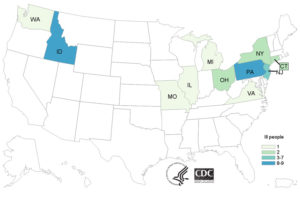
 Here are the states that are reporting.
Idaho: Public health officials in Idaho are investigating an outbreak of E. coli infections that are linked to a national outbreak affecting at least 10 other states.
At this time, eight Idaho residents have become sick with E. coli infections. All eight people who have become ill report eating romaine lettuce in the 10 days prior to becoming ill. Three individuals were hospitalized, and two have developed kidney failure linked to the E. coli infection. All hospitalized individuals were adults between the ages of 20 and 55. No deaths have been linked to this outbreak.
Initial investigations by the Centers for Disease Control (CDC) and public health officials in affected states indicate that chopped romaine lettuce from the Yuma, Ariz., growing region, could be contaminated with E. coli O157:H7 and causing illness. No common grower, supplier, distributor, or brand has been identified yet.
The chopped romaine lettuce has been consumed at restaurants and at people’s homes. As the investigation continues, public health officials at the CDC and Idaho are advising against eating pre-chopped romaine lettuce from the Yuma, Ariz., growing region until further information is known.
Public health officials in the Idaho Division of Public Health and multiple Idaho public health districts are continuing to work with the Food and Drug Administration and CDC to investigate the cause of the illnesses. Pre-chopped romaine lettuce is sold in restaurants, delis, supermarkets, and specialty food stores throughout Idaho. Public health officials advise people who have pre-chopped romaine lettuce from Yuma or an unknown source to throw it out, even if they have previously consumed the romaine without becoming ill.
E. coli O157:H7 is a type of bacteria that can cause bloody diarrhea, severe abdominal cramps, vomiting and low-grade fever.
Most people recover from E. coli O157:H7 infection in five to seven days, but for some the infection can be severe and life-threatening, especially for very young children and the elderly. Anyone who has recently consumed pre-chopped romaine lettuce and has diarrhea and severe abdominal cramps should seek medical attention.
New Jersey: Chopped romaine lettuce grown in the Yuma, Arizona region is likely the source of an E. coli O157:H7 outbreak that has sickened at least seven New Jersey residents and a total of 35 people in 11 states.
At this time, the CDC said, no grower, supplier, distributor, or brand has been identified.
Consumers who have bought romaine lettuce – including salads and salad mixes containing romaine lettuce – should not eat it and should throw it away, even if some of it was eaten and no one has gotten sick. If you don’t know if the lettuce is romaine, throw it away. Before purchasing romaine lettuce at a grocery store or eating it at a restaurant, consumers should confirm with the store or restaurant that the romaine lettuce did not come from the Yuma, Arizona growing region.
“Individuals with this infection usually get better within about 5 to 7 days, however some illnesses can be serious or even life-threatening,” said Dr. Shereef Elnahal, Commissioner of the New Jersey Department of Health. “Anyone experiencing symptoms of this illness should see a healthcare provider.”
The symptoms of E. coli infection vary. Some individuals may have mild to severe diarrhea, which may contain blood. Abdominal cramps, nausea and vomiting may occur. Usually there is little or no fever present. We encourage people to contact their health care provider if they have diarrhea that lasts for more than 3 days or is accompanied by high fever, blood in the stool, or so much vomiting that they cannot keep liquids down and they pass very little urine.
In addition, about 5 to 10% of people who are diagnosed with Shiga toxin-producing E. coli infection develop a potentially life-threatening complication known as hemolytic uremic syndrome (HUS). HUS develops about 7 days after symptoms first appear, when diarrhea is improving. Clues that someone is developing HUS include decreased frequency of urination, feeling very tired, and losing pink color in cheeks and inside the lower eyelids. Any who develop these symptoms should seek out medical care immediately.
Currently in New Jersey, DOH has confirmed a total of seven cases of E. Coli; 4 in Hunterdon County, and one each in Monmouth, Sussex and Somerset counties. As additional testing is completed, more cases may be added. DOH is continuing to work with our local health partners to identify, interview and obtain lab specimens from New Jersey residents who may have become ill from this contaminated food.
The CDC also advises that all restaurants and retailers ask their suppliers about the source of their romaine lettuce and refrain from selling or servicing any that was grown in Yuma, Arizona. The CDC and DOH will continue to provide updates as more information becomes available.
Illinois: The Illinois Department of Public Health (IDPH), along with the Centers for Disease Control and Prevention, the Food and Drug Administration, and other state and local health departments, is investigating a multi-state cluster of E. coli infections linked to chopped romaine lettuce.
Information collected to date indicates that chopped romaine lettuce from the Yuma, Arizona growing region could be contaminated with E. coli O157:H7 and could make people sick. At this time, no common grower, supplier, distributor, or brand has been identified.
One case linked to the outbreak has been identified in Illinois. To date, 35 other cases have been reported in 11 states with 22 hospitalizations and no deaths. The Illinois resident reported consuming chopped romaine lettuce before illness onset, in central Illinois.
Consumers in Illinois who have store-bought chopped romaine lettuce at home, including salads and salad mixes containing chopped romaine lettuce, should not eat it and should throw it away, even if some of it was eaten and no one has gotten sick.
If you do not know if the lettuce is romaine, do not eat it and throw it away. Before purchasing romaine lettuce at a grocery store or eating it at a restaurant, consumers should confirm with the store or restaurant that it is not chopped romaine lettuce from the Yuma, Arizona growing region. If you cannot confirm the source of the romaine lettuce, do not buy it or eat it.
Restaurants and retailers should not serve or sell any chopped romaine lettuce, including salads and salad mixes containing chopped romaine lettuce, from the Yuma, Arizona growing region.
Restaurants and retailers should ask their suppliers about the source of their chopped romaine lettuce.
People usually get sick from Shiga toxin-producing E. coli two-eight days after swallowing the germ. Most people infected with E. colidevelop diarrhea (often bloody), severe stomach cramps, and vomiting. Most people recover within one week although some illnesses can be more severe, resulting in a type of kidney failure called hemolytic uremic syndrome (HUS).
Talk to your health care provider if you have symptoms of an E. coli infection and report your illness to your local health department. You can also write down what you ate in the week before you started to get sick and talk to public health investigators if they have questions about your illness.
The following is a statement from Dr. Matthew Cartter, State Epidemiologist and Director of Infectious Diseases at the State Department of Public Health, on today’s announcement by the Centers for Disease Control and Prevention (CDC) that it is actively investigating a multistate outbreak of E. coli O157:H7, which has sickened 17 individuals in seven states, including two in Connecticut.
“We are assisting the CDC in investigating a multi-state outbreak of E. coli O157:H7 infections. It is still early in the investigation and no specific source of the infection has been identified so far.
Most people infected with E. coli will develop diarrhea, severe stomach cramps and vomiting within 3-4 days of swallowing the germ. People who develop symptoms of E. coli, should seek medical care, contact their local health department to report the illness, and try to track what foods were eaten and restaurants visited in the days prior to becoming ill.
In general, people can prevent contracting E. coli by washing hands after using the restroom or changing diapers, before and after preparing or eating food and after contact with animals; cooking meats to proper temperatures; thoroughly washing all surfaces that touch raw meat; washing fruits and vegetables before eating; avoiding unpasteurized dairy products; and avoiding preparing food or drinks for others when you are sick.”